








They'll do one more for Pep.

For children who are building their first words and need a reason to keep trying.

Short picture lessons on a tablet, with a friend your child picked cheering every right answer.

aris.stageslearning.com/lesson
Stages Learning · ARIS Digital Lesson · Independent trial Live
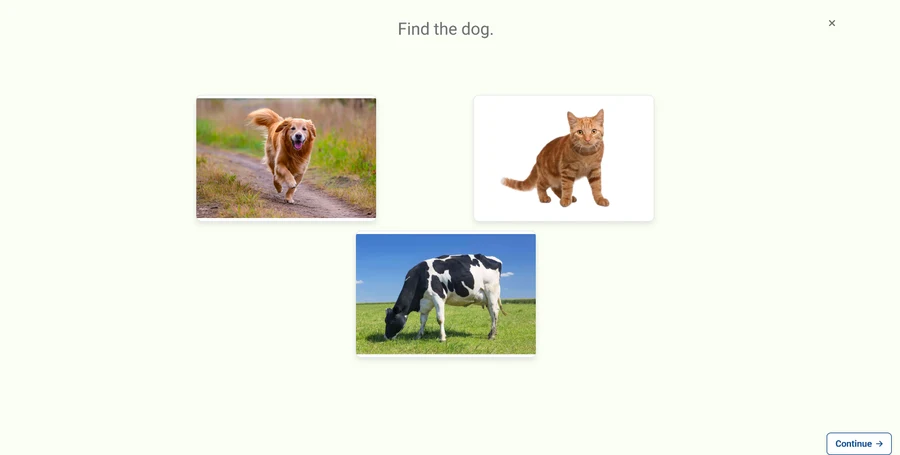
An ARIS digital lesson asking the learner to find the dog, with three real photographs to choose from
Pep the dog, cheering
Ms. Mila the squirrel

It is not something you park your child on

There is no endless path to wander down and no reward for time spent. A lesson is a few turns on one skill you chose, and then it ends. You set each of these for your child.

  • Which cards

    The card library or your own pictures: a child's own cup, their own dog.

  • How much help

    Where prompting starts and how quickly it fades, for each learner and each skill.

  • What a wrong answer does

    Some learners need a gentle “almost”. Others are thrown by it.

    Try again “Almost”
  • Sound

    A shared table and a learner sensitive to noise need different things.

    On Quiet Off
  • Who appears

    The learner's own favorites, found by the preference check, not guessed at.

  • On paper or on screen

    The same lesson runs with printed cards, and the data lands in the same record.

What one lesson looks like

Your child hears a word and touches the matching picture. A lesson is a few of these on one skill you pick.

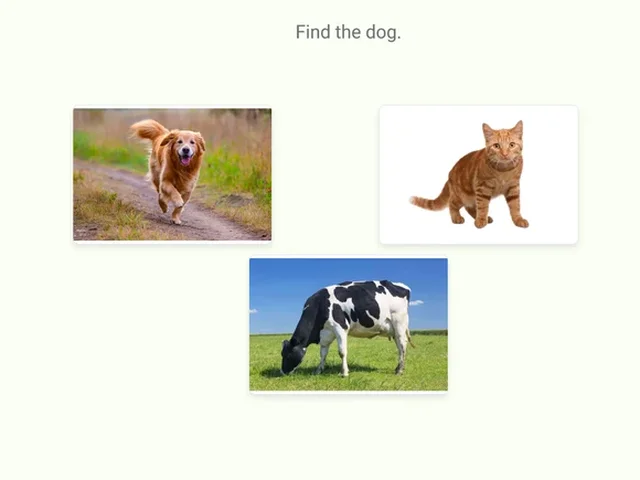
  1. An ARIS digital lesson asking the learner to find the dog, with a dog, a cat and a cow to choose from

    “Find the dog.”

    The instruction is spoken, and three real photographs come up.

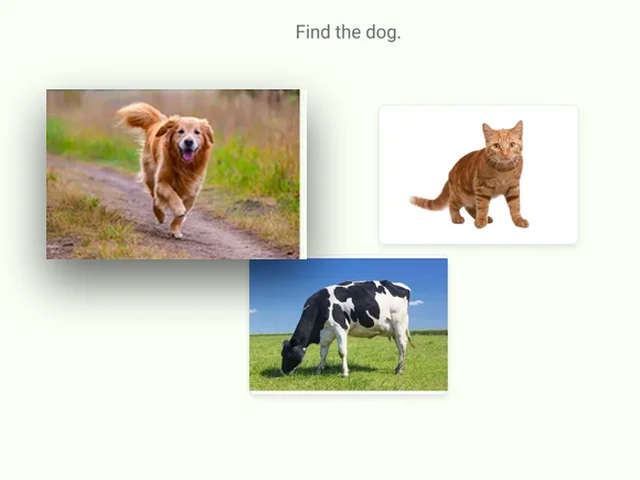
  2. The same trial a moment after the dog is touched: the dog's card larger and lifted above the cat and the cow

    They touch the dog.

    It grows and comes forward, so they see they got it. Early on, the right card is outlined until they no longer need the help.

  3. Pep the dachshund leaping to catch a tennis ball

    Pep comes bounding in.

    The friend they chose celebrates, in his own voice. That is why they do the next one.

  4. Digital lessons history

    Receptive Labeling · 2D Picture Nouns

    86%

    6 of 7 correct · today

    It is already written down.

    Every answer is scored and saved with the date, automatically.

Try the first turn with your own child. Free for 14 days. Start a free trial →

The friends

First, your child meets the friends

A short cartoon: a few friends, a small problem, solved together. At the end one of them turns to your child and asks who they want to play with.

The Meadow Pack

Fetch!

The end of Fetch!, and the question the whole check turns on. Pep asks it; the choices are Pep, Velvet, Trill and Juni.

The Springs Line Crew

First to the Station

A different group, in a different corner of town. Zoomer the car introduces himself, with Tempo the train beside him.

Animals, vehicles and toys. A child who does not care about a dog may love a train.

Why start with a cartoon?
  • Children with autism learn from animated characters. In a study of The Transporters, a cartoon of vehicles with real faces, 20 autistic children aged 4 to 7 watched it every day for four weeks.
  • Their emotion recognition improved significantly more than a matched group who did not watch it, and ended level with typically developing children.
  • A later trial with 77 children found the gains carried over to new faces and situations, and were still there three months on.
  • Learning by watching works. A meta-analysis of 23 studies found that video modeling helps children and teenagers with autism learn new skills, keep them over time and use them with new people and in new places.
  • ARIS has its own cartoons, not The Transporters. They work on the same idea: a learner meets the friends on screen before being asked to choose one.

Sources

  1. Golan et al. (2010). Enhancing emotion recognition in children with autism spectrum conditions: an intervention using animated vehicles with real emotional faces. Journal of Autism and Developmental Disorders.
  2. Gev, Rosenan & Golan (2017). Unique effects of The Transporters animated series and of parental support on emotion recognition skills of children with ASD. Autism Research.
  3. Bellini & Akullian (2007). A meta-analysis of video modeling and video self-modeling interventions for children and adolescents with autism spectrum disorders. Exceptional Children.

Or watch one all the way through

Forty seconds, sound on. This is the whole of Fetch! — the same thing a learner watches before they are asked to choose.

Four more like it, one per group of friends.

Then they pick the one they want

Your child taps the friend they like best, a few times over, so it is their choice and not a guess. From then on, that friend comes bounding in for every right answer.

Stages Learning · ARIS Lesson 1 · Digital Live
Kip
Pep
Nova

● a tap on Pep

A few friends at a time. The child taps the one they want. The picked card leaves its place empty and the rest stay exactly where they were, so the next choice is not a new puzzle.
Stages Learning · ARIS Lesson 1 · Digital Live
Pep catching a frisbee
The friend they picked comes forward and does one of their moves, in their own voice. Choosing is immediately worth something, which is what makes a child choose again.
Stages Learning · ARIS Lesson 1 · Digital Live

Lesson 1 · Digital

Marcus's picks today

3 sets · Saved to Marcus's digital reinforcers

  1. 1 Pep 3 of 3
  2. 2 Nova 2 of 3
  3. 3 Kip 1 of 3
The ranking is saved to the learner, and from then on a favorite is who turns up for a correct answer in every lesson. Run it again whenever a child changes their mind — and they do.
Why let the child choose their reward?
  • A reward only works if the child actually wants it, so ARIS finds out instead of guessing.
  • A review of 30 studies with people with severe developmental disabilities found that offering choices led to less inappropriate behavior and more appropriate behavior.
  • The same review found that preference assessments, like the check ARIS runs, reliably pick out the things that work as rewards.

Sources

  1. Cannella, O'Reilly & Lancioni (2005). Choice and preference assessment research with people with severe to profound developmental disabilities: a review of the literature. Research in Developmental Disabilities.

Watch your child choose. Free for 14 days. Start a free trial →

Twenty-one friends, so it never gets old

Each one has a look, a voice and moves of their own. Hover one to meet them.

Pep

Pep

Dachshund · The Meadow Pack

Host of the ARIS Stage and first to cheer for anyone. He celebrates with a tennis-ball leap, a frisbee catch or a belly-up wiggle, all big feelings. A long little dachshund with floppy ears and a tail that never stops.

In Fetch!: Pep's ball lands in a bush, and Trill, Juni and Velvet help him get it back.

Each friend has moves of their own, so the one a child picked never gets boring and never turns into one animation they learn to tune out.

Five cartoons, one town

The friends a child chooses between are friends they have met

Each cartoon follows one group through a small problem they solve together. So when the question comes, a learner is picking a friend they have watched, not a button.

  • Fetch! — Pep's ball lands in a bush, and Trill, Juni and Velvet help him get it back.
  • First to the Station — Rumble's big load blocks Tempo's track, and Lulu makes room so everyone still gets to the station.
  • The Big Flower — The big flower is droopy, so Digby brings water, Fern sneezes, and slow and steady, it grows.
  • Splash Show — Wink's magic hat floats away down the creek, and Coral brings it back so the show can go on.
  • Off to the Show! — Tum-Tum has no legs to get to the show, so Breezy and Nova fly him there and the Stage Crew puts on a show.

Built the way children like yours learn

The same teaching special education teams use, made simple enough for a kitchen table.

Right from the start

At first the right picture is outlined, so your child gets it right. The help fades as they need it less, until they are doing it on their own.

Why does errorless teaching work?
  • A systematic review gathered 28 studies of errorless teaching with 283 people with intellectual and developmental disabilities.
  • In most of them, errorless methods improved how well learners told pictures and objects apart: the same skill a digital lesson's "Find the cow" practices.
  • The prompt is faded step by step, so the learner keeps being right while the help is taken away.

Sources

  1. Markham et al. (2020). Applications of within-stimulus errorless learning methods for teaching discrimination skills to individuals with intellectual and developmental disabilities: a systematic review. Research in Developmental Disabilities.

Real photographs

Every picture is a real photograph, the same ones printed on our cards, so what they learn on the screen is what they see in their hands and around the house.

Why real photographs instead of drawings?
  • The closer a picture is to the real thing, the easier it is to understand. A study of 40 nonspeaking people with intellectual disabilities, autistic learners among them, found a clear order of difficulty: real objects easiest, abstract symbols and written words hardest.
  • Color matters too. Autistic children understood color photographs more easily than line drawings, and carried a new word over to the real object more often when it was taught with a color picture.
  • That is why the lessons use the same color photographs as the printed cards in the kit.

Sources

  1. Mirenda & Locke (1989). A comparison of symbol transparency in nonspeaking persons with intellectual disabilities. Journal of Speech and Hearing Disorders.
  2. Hartley & Allen (2015). Iconicity influences how effectively minimally verbal children with autism and ability-matched typically developing children use pictures as symbols in a search task. Autism.
  3. Hartley & Allen (2015). Symbolic understanding of pictures in low-functioning children with autism: the effects of iconicity and naming. Journal of Autism and Developmental Disorders.

Progress you can see

Every answer is saved with the date and the score, so you can see what your child knows this week that they did not know last week.

Why does recording every trial matter?
  • When teachers in special education track progress regularly and act on it, students learn more.
  • A meta-analysis of 21 controlled studies found an average effect size of 0.70, a substantial gain for a change in how teaching is checked rather than what is taught.
  • How the data was displayed was one of the things that changed the size of the gain.

Sources

  1. Fuchs & Fuchs (1986). Effects of systematic formative evaluation: a meta-analysis. Exceptional Children.

Which plan?

Practice on a screen, or a whole curriculum you teach

ARIS Online: Picture Lessons

Your child practices. You pick the skill.

Short picture lessons your child does on a tablet or computer, with a friend they chose cheering each right answer. You choose what to practice and see how they are doing.

Best if your child is in school or therapy and you want practice at home, or you are waiting for services and want to start now.

$24.99 a month, or $249.99 a year

ARIS Online: Homeschool Curriculum

You teach a complete program, step by step.

The full ARIS curriculum: an assessment shows where your child is, a plan says what to teach next, and every lesson comes with a guide and a video. The picture lessons are included for practice.

Best if you are your child's main teacher.

$99.99 a month, or $999.99 a year

What each plan includes
What you get Picture Lessons Homeschool Curriculum
Picture lessons with the friends, and the check that finds your child's favorite ✓ ✓
Real photographs, the same ones printed on our cards ✓ ✓
Lessons you build yourself ✓ ✓
Every answer saved, so you can see progress week by week ✓ ✓
Ready-made lessons 100+ for early language All 202 ARIS lessons, first words to early reading and math
An assessment that finds where your child is, and a plan from it — ✓
Lessons that line up with IEP goals — ✓
A video and guide for teaching each lesson — ✓
A journal to record and share progress — ✓
One-hour onboarding, live webinars and email support ✓ ✓
14-day free trial ✓ ✓

Both plans are digital. Printed cards and kits are sold separately, and you can add them any time.

Two plans

Try it free for 14 days.

Help me choose a plan →
Both include: the picture lessons, the friends and the check that finds your child's favorite

Picture lessons

ARIS Online: Picture Lessons

Short picture lessons your child does on a tablet or computer.

$24.99 / month

14-day free trial

Yearly saves $49.89 versus 12 monthly payments.

  • Ready-made picture lessons for first words, and lessons you build yourself
  • Real photographs, the same ones printed on our cards
  • The friends, and a check that finds the one your child wants
  • Every answer saved, so you can see progress week by week
Start a free trial

Homeschool curriculum

ARIS Online: Homeschool Curriculum

The full ARIS curriculum, taught at home, with the picture lessons built in.

$99.99 / month

14-day free trial

Yearly saves $199.89 versus 12 monthly payments.

  • Everything in Picture Lessons
  • All 202 ARIS lessons, from first words to early reading and math
  • An assessment that finds where your child is, and a plan from it
  • Lessons that line up with IEP goals
  • Videos and guides for teaching each lesson
  • A journal to record and share progress
Start a free trial

Free for 14 days. A card is needed to start, and it is charged on day 14 at the price shown unless you cancel before then. Secure checkout with Stripe.

Try it with your child tonight

Free for 14 days. If it is not for you, cancel before day 14 and you pay nothing.